New KWD Market Report on Heating & Plumbing Pipes in Europe published
 Somehow, we had hoped to find a more carefree political and economic situation this year, one that would allow for significantly more positive forecasts, but unfortunately, that did not come to pass.
However, Euroconstruct expects to see slight increases in new construction again starting in 2026, even though the network also had to revise its projected new construction figures downward. However, renovation remains an important factor, and this sector also requires a significant number of meters of pipe.
According to Euroconstruct, residential construction will indeed begin to expand again starting in 2026, and the new-construction segment will grow by a total of 14% by 2028. However, the completion rate per 1,000 residents will increase by a modest amount, from just under 3.0 to only 3.2 housing units by that time. Meanwhile, according to the network, the focus is increasingly shifting to the existing housing stock, whose share of residential construction output rose by a good five percentage points to over 62% between 2021 and 2024. This reflects the growing need for renovation and remodeling, the importance of government subsidies, but also the challenges facing new construction, which contracted by 17% from 2023 to 2024. With the expected revival of new construction, the share of work on existing housing stock will fall back to just under 60% by 2028.
ggg
Structure of the KWD Market Study
As always, we have estimated the current and future pipe consumption in the Euroconstruct area for this KWD Market Report on the basis of statistical values and forecasts for completions and modernizations in residential and non-residential construction. The data from the Euroconstruct Summer Conference 2026 served as the basis for this.
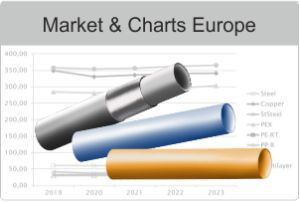
The KWD Market + Charts report “Heating & Plumbing Pipes Europe 2026” estimates the pipe quantities in millions of meters used in domestic installations in the 19 Euroconstruct countries for the years 2024 – 2028. As always, the estimated pipe quantities are broken down by application areas and pipe materials.
The sector of Heating & Plumbing Pipes is divided into the three areas:
- Surface heating & cooling (floor, wall and ceiling)
- Radiator connection
- Sanitary installations
The application areas are broken down by the following pipe materials:
- Metal pipes: steel / copper / stainless steel
- Plastic pipes: PEX / PE-RT / PP-R / PB
- Multilayer composite pipes: PEX or PE-RT with a middle layer of Aluminium
Trends in pipe materials
Looking at the study period – that is, 2 years before and 2 years after the current year, 2026 – it appears that the market positions of pipe materials have stabilized.
- It is certainly still the case that PE-RT is gaining ground somewhat in the underfloor heating sector and is undoubtedly taking market share from PEX, but this is only noticeable on a smaller scale.
- And in the area of hot- and cold-water installations as well, the market positions are quite stable. Copper continues to face challenges due to persistently high price increases and is losing market share to multilayer pipes, but this trend is also noticeable only to a limited extent.
The massive shifts in materials that we saw more than 10 years ago, have calmed down.
The price of the study remains at 1,200 € for our subscribers of KWD-globalpipe and KWD-SHK (see our newsletters), for all others 1.450,- € (in Germany plus Tax, abroad with prepayment). Authors are as always Jutta Hix, chief editor of the KWD information services and Achim Seydel of Seydel Consulting. We are happy to accept orders here via our website, or alternatively by email.The KWD Market Report is only available in digital form.
PIPEXPERT: New OEM partner for quality plastic pipes in plumbing & heating sector
 The company focuses on the global distribution of OEM and private-label solutions and offers customers a wide range of configuration options to meet their specific product and brand requirements.
Technology – PE-Xa smooth pipe with infrared cross-linking: The company’s core product is PE-Xa smooth pipe, manufactured using infrared cross-linking and production processes. This technology enables particularly homogeneous cross-linking and ensures high material durability as well as maximum performance. “Thanks to the cross-linking and oxygen impermeability, the pipe achieves exceptional quality and top performance,” explains Managing Director Michael Walter.
Partnership-based approach & extensive industry experience: pipexpert GmbH relies on a team with extensive experience in the plastic pipe industry. A partnership-based approach to working with customers and suppliers is a central component of the company’s philosophy. “The industry is closely networked – people know each other and trust one another. That’s exactly what we build on,” adds Founder & CEO Michael Pfister.
Flexibility for OEM and private-label customers: A key added value lies in the wide range of configuration options for products and packaging. These include custom pipe markings, customer-specific lengths, bundle sizes, and packaging units, as well as flexible branding and logistics solutions. This positions pipexpert GmbH as a modern, customer-oriented OEM partner.
A look to the future: The product portfolio will be gradually expanded. In addition to PE-Xa, PE-RT, PE-Xb, corrugated pipes, and aluminum composite pipes, additional components for underfloor heating systems as well as innovative fitting concepts are planned for the future.
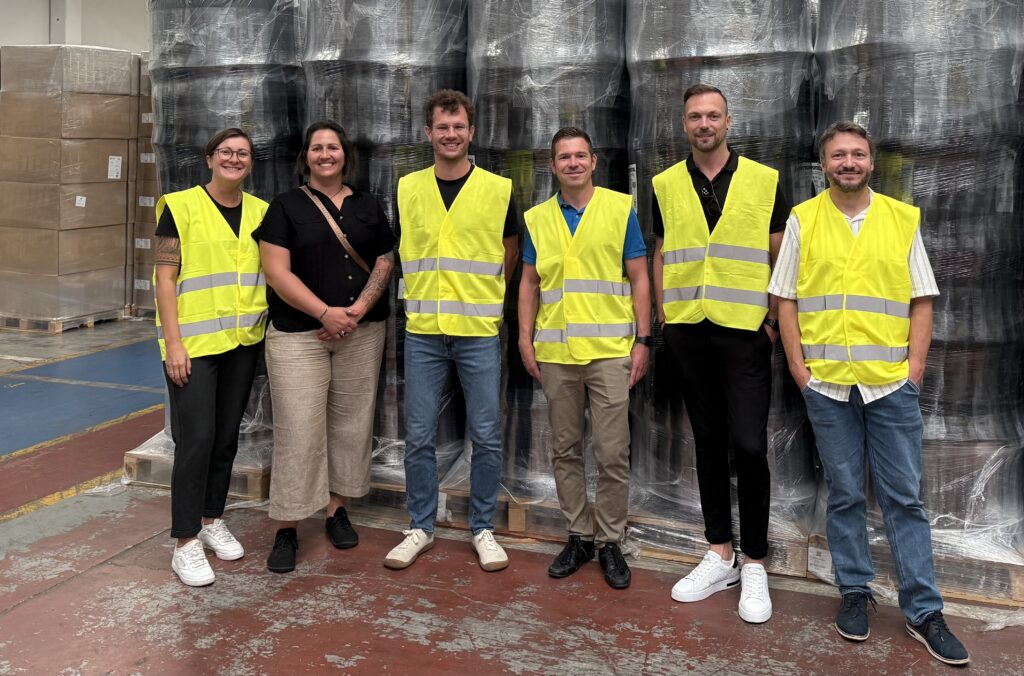
From left to right: Nicole Haberstock (Area Sales Manager), Eva-Maria Menzel (Supply Chain Operator), Michael Pfister (Founder & CEO), Michael Walter (Managing Director), Sebastian Kaiser (Area Sales Manager) and Johannes Stumpf (Area Sales Manager). © pipexpert
HENCO launches World first synthetic manifold with integrated taps
One of the main advantages of a manifold is that individual circuits can be easily shut off for maintenance without stopping the entire system. And with a dedicated pipe circuit for each tap point, floor connections can be avoided. With the Henco Pro-Flow Manifold, Henco sets a new milestone in product development.
Unique features: What sets the Henco Pro-Flow Manifold apart from traditional systems is its fully inte-grated design with ball valves. The modular design ensures a compact installation without the need for multiple T-connectors, significantly reducing installation time. The system is also self-aligning: when the different modular manifolds are screwed together, the thread with integrated click notch ensures a perfectly aligned installation. Thanks to specially developed wall brackets with click function, mounting is child’s play. The blocker ring on the Eurocone connections guarantees a simple and safe installation.
Lightweight and sustainable: The Henco Pro-Flow Manifold is a lightweight alternative to traditional brass manifolds. Its low weight is a major advantage for storage, transport and use on site – and it is less prone to theft. Synthetic material also reduces the risk of condensation, which is important in cooling water systems and climate ceilings. It also minimizes the risk of blockage due to lime deposits, and the smooth interior ensures better flow (and thus safety) of drinking water.
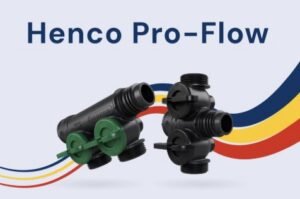
Versatile and modular design: The Henco Pro-Flow Manifold is available in versions with 2 or 3 outlets and can easily be expanded to 12 circuits. This makes the system extremely flexible for various applications, such as drinking water installations, hot and cold water, hydronic heating and chilled water with glycol. The integrated ball valves feature color-coded handles (red, blue, green and black), so
different circuits can be visually distinguished. This ensures a clear and safe installation and simplifies maintenance.
100% Belgian quality: The Henco Pro-Flow Manifold was fully developed and produced in-house at Henco’s Belgian site. Previously, brass manifolds were purchased, but now Henco has full control over the production process and quality. This not only results in shorter lead times and lower costs, but also represents a major step forward in sustainability through less heavy transport and fewer raw materials.
KWD Fitting Report Europe – Update 11/2025

Our KWD Market Report “Fittings and Pipe Connections for Heating & Plumbing Pipes Europe 2025” has now been published. The digital KWD Market Report contents the study as a pdf-file and all figures – including the analysis of used fittings by connection type – as an Excel file.
Once again, this report aims to provide an overview of the connection types of fittings, developments, trends and changes since our last report in 2022. In the main section of KWD Fitting Report we estimate the consumption of fittings by application (surface heating, radiator connection, plumbing installation) and pipe material for the EC 19 countries as defined by Euroconstruct.
Contents of the report:
- Terms and Definitions
- Basic Designs of Pipe Connections
- Analysis of used Fittings by Connection Type and Material
- Consumption of Fittings by application and pipe material
- Company profiles
Evaluation of the survey: For this market study, we have once again launched a survey to determine per country which of the connection types are used in what percentages and what proportions of plastic or metal are used as materials. We had sent the request to participate in the survey to a lot of people in Europe who should be familiar with the fitting market. We then sorted the responses by country and evaluated those for which we had received enough responses.
So in the KWD Fitting Report Europe 2025 we can provide you with information on the use of fittings by connection type in the following countries: Austria, Belgium and Netherlands, Germany, Great Britain, Italy, Spain and Poland.
Surprisingly, press fittings do not have as high a market share as we would have expected. However, in terms of materials, the result was as we would have expected: metal has a higher market share, but plastic is holding its own. Detailed information on this can be found in the current KWD Fitting Report.
The KWD Fitting Report Europe 2025 costs € 970,- for subscribers (€ 1.200,- for everyone else) plus MwSt. in Germany.
For more information and page samples please visit: https://www.globalpipe.de/market-reports/on-fittings-heating-plumbing/ .
We are also happy to answer any questions you may have. Please use the contact form for this purpose.
KWD Market + Charts “Heating & Plumbing Pipes Europe 2025” – Report now published
KWD Market + Charts “Heating & Plumbing Pipes Europe 2025” – Report now published
Due to various political uncertainties we decided not to publish the KWD Market+Charts study in February as usual, but to wait until the summer and use the Euroconstruct data from June 2026 as the basis for new builds and modernisation.
KWD-globalpipe, 25.04.2024. As always, we have estimated the current and future pipe consumption in the Euroconstruct area for this KWD Market Report on the basis of statistical values and forecasts for completions and modernisations in residential and non-residential construction. The data from the Euroconstruct Summer Conference 2025 served as the basis for this.
The KWD Market + Charts report “Heating & Plumbing Pipes Europe 2025” estimates the pipe quantities in millions of meters used in domestic installations in the 19 Euroconstruct countries for the years 20223 – 2027. As always, the estimated pipe quantities are broken down by application areas and pipe materials.
We divide the sector of Heating & Plumbing Installations into the three areas: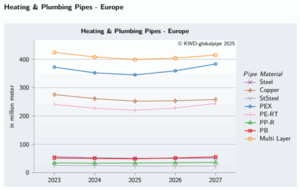
- surface heating & cooling
underfloor, wall and ceiling) - radiator connection
- sanitary installations
The following pipe materials are analyzed by applications:
- Metal pipes: steel / copper / stainless steel
- Plastic pipes: PEX / PE-RT / PP-R / PB
- Multilayer composite pipes: PEX or PE-RT with a middle layer of Aluminium
The volume estimates are based on the new construction and modernisation figures for residential and non-residential construction published twice a year by the Euroconstruct network, each with a three-year trend. The KWD Market + Charts report is based on the figures from the Euroconstruct study published in June 2025. According to Euroconstruct, the ongoing decline in residential construction will not allow for any significant growth in construction activity in 2025. Increases are expected again from 2026. The study concludes that demographic trends and rising household incomes will provide somewhat stronger impetus for European residential construction in all countries.
It should be noted that this statement refers to all 19 countries as a whole, but there are still differences when looking at the individual countries. While declines of 14 – 20 % are expected in the new construction sector in 2025 for Norway, Austria, Germany, Denmark, Finland and France, Sweden expects an increase of 21.3 %, Spain of 12.4 % and Ireland of 9.1 %. This development is discussed in detail in Chapter 2 of the study.
Development of pipe materials by area of application in Europe:
- Even though PEX pipes are still the leading choice for surface heating throughout Eu-rope, PE-RT has caught up significantly in recent years. Compared to all other pipe types, however, PEX and PE-RT are the leading choices when it comes to materials for surface heating pipes.
- In radiator connections, copper and multilayer pipes are also still in a neck-and-neck race, with multilayer pipes having a slight lead but not being able to extend it.
- In sanitary installations, multilayer has been far ahead for many years, followed at a considerable distance by copper.
Crisis Calculator: As external influences on construction have still not subsided, we will once again be offering our tried-and-tested crisis calculator. It can be used by anyone to change forecasts for 2026 and 2027 individually per country by entering a percentage change.
The price of the study remains at 1,200 € for our subscribers, for all others 1.450,- € (in Germany plus Tax, abroad with prepayment). Authors are as always Jutta Hix, chief editor of the KWD information services and Achim Seydel of Seydel Consulting. Orders will be accepted by email or completed order form. The study is only available in digital form.
GF Flow Building Solutions: Decades of reliability for professionals – 30 years with Uponor Quick & Easy
30 years with Uponor Quick & Easy
In 1994, Uponor set a milestone in the HVAC industry with the introduction of the Quick & Easy system. By utilizing the unique material properties of PEX-a pipe, it was possible to create pipe connections that were stronger than the pipe itself – a groundbreaking innovation for installers worldwide. Three decades and over 500 million fittings sold later, Uponor Quick & Easy remains the preferred choice of professionals who value ease of installation and exceptional durability.
In 1972, Uponor (now GF Building Flow Solutions) launched the world’s first PEX pipes on the market, revolutionizing an entire industry. The plastic pipe system for drinking water and heating installations meets all the requirements for hygienic installations. Made of high molecular polyethylene plastic, the pipes do not release any taste, odor, heavy metals or substances into the drinking water; the durable material is not affected by high flow speed or water with a low pH value. The memory effect and the high resilience of the pipes form the basis for Uponor Q&E (Quick & Easy) connection technology, with which Uponor set a new standard for pipe connections in 1994.
Innovative connection technology with minimal installation effort
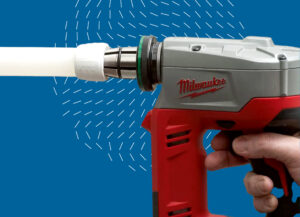
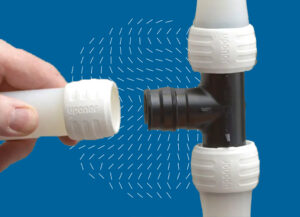
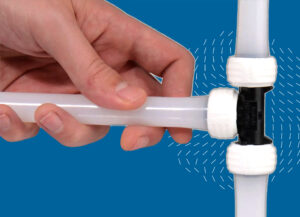
With Uponor Quick & Easy, the name says it all, because the fittings are connected to the pipe in three simple steps: Expand the pipe and the fitted Q&E ring. The expanded pipe is then pushed onto the end of the fitting. The final step is performed by the material itself; the connection is made in seconds as the pipe is shrinking. “Our Uponor Q&E fittings require no solder, torches, fluxes or solvents for the installation. The pipes’ unique shape memory forms a tight seal around the fitting, creating a strong, reliable connection in seconds,” says Charlotta Persfell, Chief Marketing Officer, GF Building Flow Solutions. “And with minimal effort, saving installation time and costs.”
The combination of the unique jointing technologies and the proven performance of the Uponor PEX pipes is one of the reasons for the success of the PEX pipe system around the globe. Charlotta Persfell says: “In North America, Uponor is recognized as a leader in flexible polymer piping solutions with the industry’s most tested, listed, and code-approved PEX piping product on the market. Based on the same principle of PEX expansion connection like Q&E, the jointing system ProPEX® compliant to F1960 standard provides pipe connections our customers rely on for decades.”
Ongoing product development as part of the success story
Driven by the ongoing pursuit of innovation, GF Building Flow Solutions continuously invests in the development of its solutions, introducing new features and improvements based on customer feedback and market requirements. “In 2023, we launched the world’s first bio-based PEX pipe1 and with this, reducing the carbon footprint up to 90% compared to fossil-based PEX pipes,“ says Charlotta Persfell. “With this product we have made a major step forward to serve the emerging need of
sustainable construction, supporting our customers to make sustainable choices, set new standards and achieve their environmental goals. “
Customer satisfaction that convinces – for 30 years
With over 500 million fittings sold, Uponor Quick & Easy is one of the systems that professionals rely on when it comes to reliable, easy-to-install and durable pipe connections. “Our proximity to our specialist partners and their practical expertise are key drivers for our product development. The positive feedback from our specialist partners confirms our commitment to products that enable efficient, safe and stress-free installation,” says Charlotta Persfell.
Alberto Tejero from Istalaciones (Spain) says: “For over 20 years, we have relied on Uponor’s Quick & Easy system for our installations. The system’s speed, cleanliness, and safety – especially compared to our previous work with copper – have made it our preferred choice. The flexibility of the pipes, along
with a wide range of accessories, allows us to work even in hard-to-reach spaces.”
Sig. Halvorsen from Sandnes (Norway) says: “We’ve relied on the Quick & Easy system since 1998,
initially choosing it for its safer connection technology compared to the commonly used screwed
systems of the time. What stands out to us is the system’s reliability – leaks are rare, and the design
makes incorrect installation nearly impossible, ensuring safety on every project.”
Advantages of the Uponor Q&E system at a glance:
• Proven quality: Known for reliability and innovative performance for over 30 years
• Strong connections: Permanent tightness thanks to the memory effect of PE-Xa pipes
• Easy installation: Significantly reduced installation time and costs
• Long-lasting: No pitting, scaling or corrosion
• User-friendly and safe: Low-error, self-explanatory system, no O-rings or other movable parts,
reducing risks of leakages, no solder, torches, fluxes or solvents required for the installation
• Versatile: Suitable for water and heating installations in residential, commercial and industrial
buildings
Beulco: New EU Drinking Water Directive – challenges and opportunities for manufacturers and users
New EU Drinking Water Directive and Positive List of Materials: Stricter lead limits and lead-free materials – challenges and opportunities for manufacturers and users
The European Commission is committed to continuing to ensure the supply of high-quality drinking water, taking into account the latest scientific recommendations. Therefore, the European Drinking Water Directive (TWR) 2020 was revised. The new revised TWR 2020/2184 came into force in 2021 and was to be implemented in all EU member states by January 12, 2023.
The update of the Drinking Water Directive mainly focuses on materials that come into contact with drinking water. The changes relate to current quality standards for microbiological, chemical and indicator parameters. These include new requirements for lead concentration. The permissible lead concentration has been reduced from the current 10 µg/l at the tap to 5 µg/l. These parameters must be met by January 2036. Germany has decided to incorporate the new parameters into the Drinking Water Ordinance already, so that the values will become mandatory from 2028, and only components that come into contact with drinking water and are made of such a material may be sold and installed.
In addition, the European Chemicals Agency (ECHA) has created an EU positive list of materials. This list defines hygiene requirements for products that come into contact with water, such as pipes and fittings, and works in conjunction with Article 11 of the Drinking Water Directive. The list specifies which materials can be used.
With the introduction of the new EU positive list of materials, the EU is taking a significant step towards ensuring drinking water hygiene. This list includes numerous materials and products for use in drinking water systems and aims to protect water quality and consumer health.
Both regulations work together to reduce the lead content in materials and drinking water.
© BEULCO
What does this mean for distributors and customers?
BEULCO recommends that affected companies adjust their product portfolio of corresponding products by the end of 2026. This enables a timely conversion to compliant materials and provides sufficient leeway to offer compliant products for installation by 2028. For many companies, this means a fundamental revision of their product range and production processes. The changeover to lead-free materials is not only necessary to comply with the regulations, but also puts the companies placing the products on the market in a future-proof position, especially with regard to possible future regulations that could assess lead limits and mass fractions even more strictly.
From 1 January 2028, only compliant products may be installed in the installations. From 2026, new approval seals are expected to come onto the market, which will supplement or replace the existing seals such as DVGW and KIWA.
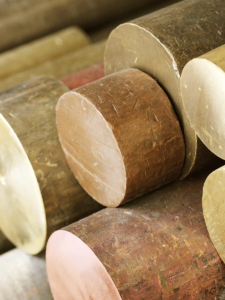
In response to these developments, BEULCO started to switch to the lead-free material CW724R (Cuphin/ Ecobrass) and to adapt its product range accordingly more than 10 years ago. In 2026, the entire portfolio of products for applications in contact with drinking water will consist of lead-free alternatives. In addition to CW724R, other lead-free alloys and alternatives are also being tested.
The conversion to lead-free materials is of the utmost urgency in view of the stricter EU regulations. Companies that do not meet the new limit values in time risk not only considerable legal and financial consequences, but also a competitive disadvantage. Compliance with the new requirements requires an early adaptation of the production processes and a strategic realignment of the product portfolio.
BEULCO provides comprehensive information on this topic on its website and is available to assist both distributors and users of products containing lead with its expertise.
EU legislation | The significance for the lead processing industry | BEULCO
REHAU: The new sustainable universal pipe RAUTITAN flex green saves 90% CO2
Sustainable construction is not only becoming ever more important but is also increasingly becoming the norm. The new drinking water and heating pipe, RAUTITAN flex green can save more than 90% CO2 in the manufacturing process. It is based on renewable, bio-based raw materials and can help to achieve sustainability targets.
 RAUTITAN flex green is a drinking water and heating pipe made of PE-Xa. What makes it special is that the plastic is made from renewable, biocircular raw materials. For example, vegetable fats are used, which are produced as waste and by-products in the food industry. External and independent certification by ISCC Plus ensures that the proportion of renewable raw materials can be tracked transparently along the value chain. ISCC Plus (International Sustainability & Carbon Certification) is a global certification program with the aim of establishing sustainable raw material chains.
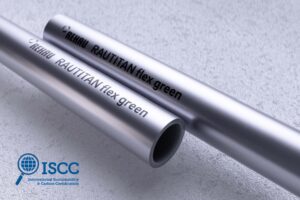
The polyethylene used is mass-balanced and consists of 100% renewable, biocircular raw materials. © REHAU
The polyethylene used is mass-balanced and consists of 100% renewable, biocircular raw materials. This means that the production of RAUTITAN flex green saves more than 90% CO2 compared to standard fossil based PEX pipes on the market.
The new RAUTITAN flex green offers the same benefits as the tried and tested RAUTITAN flex:
- Just as clean: The lead-free RAUTITAN flex green pipe system is hygienically optimised for drinking water installations. The smooth inner pipe walls and excellent impermeability of the cavity-free jointing technology effectively prevent contamination.
- Just as flexible: RAUTITAN flex green is highly unlikely to buckle, especially in the case of small pipes. Despite this, the pipe is flexible: you can easily bend it over your thumb without any tools, even at low temperatures.
- Just as reliable: RAUTITAN flex green achieves a permanently leak-tight connection with fittings and compression sleeves. The pipe itself is the sealant, with no O-rings and no manual labelling.
The pipe is made of high-performance PE-Xa plastic and contains a special oxygen diffusion barrier – making it suitable for both drinking water installations and heating. RAUTITAN flex green complies with DIN EN ISO 15875 and is oxygen-tight in accordance with DIN 4726. It can be used universally for drinking water and heating installations and is compatible with the REHAU RAUTITAN system of pipes, fittings, sliding sleeves and tools.
Contact: REHAU Industries SE & Co. KG, Germany, www.rehau.com
SANHA wall heating module demonstrates specific advantages

© Sanha
Wall heating systems are among the most efficient types of heat transfer. As surface heating, they are extremely well suited for combination with heat pumps, for example. In contrast to comparable systems, SANHA wall heating modules offer the advantage that they can provide heat both in the low temperature range and up to 60 °C. In addition, they are much easier to install. They are also much easier to install.
An old building in the south of Essen is currently being fitted with wall heating modules. This is an example of how our systems can demonstrate their advantages and support energy-efficient refurbishment at the highest level in a technology-neutral way.
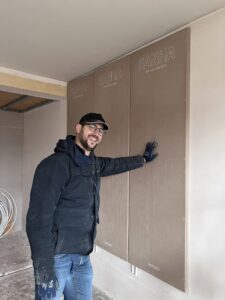
© Sanha
The building, built in 1977, is currently undergoing a comprehensive energy refurbishment. This includes efficient façade insulation as well as a modern heating system based on natural gas condensing heating. A total of two floors with five rooms (one downstairs, four upstairs) are to be heated. The calculated heating load of the upper floor (85 m²) is around 2.5 kW (assuming 30 K to the outside temperature), which is optimally provided by wall heating modules, while the first floor is supplied with heat via underfloor heating.
The client opted for SANHA® wall heating modules primarily because of their high flexibility. The maximum heat output is up to 210 W/m², which is higher than comparable products. This means that wall heating modules can be operated very efficiently in the low temperature range during the transitional period and still use the high possible flow temperatures of the natural gas heating system on particularly cold days.
Another reason why the client chose SANHA® wall heating modules was the ease of installation: using a mounting rail and dowels, they are much easier to install than underfloor heating, for example; there is no need for labor-intensive ripping up of the floor and subsequent re-installation, drying times for the screed, etc. – a clear advantage.
Added to this was the fact that neither the wall heating modules nor the underfloor heating generate any convection or dust: “As an allergy sufferer, this aspect was very important to me,” says the client. The upper floor, which is particularly exposed to the sun on hot days, can also be cooled by the wall heating modules if necessary. This is particularly true for a studio with high ceilings.
Dew point undercutting and mold prevention
Wall heating also makes sense when it comes to preventing mold on the walls. Mold develops when water vapor from the air condenses on colder objects, i.e. when the temperature falls below the dew point (or dew point temperature). The type of ventilation also plays a role: it is better to ventilate several times a day than to keep the window tilted. Conventional convection heating systems cannot prevent moisture loss or condensation in every situation, as the warm air collects on the ceiling and sinks downwards after cooling – and can provide an ideal breeding ground for mold in the cooler areas of the wall.
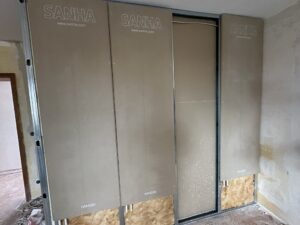
@ Sanha
Wall heating works on the principle of the sun
Wall heating, on the other hand, does not primarily heat the air, but warms objects and people through heat radiation – similar to the sun. This is not only perceived as very pleasant, but also ensures lower humidity. In addition, this type of panel heating does not cause any draughts or swirling up of dust. Conventional radiators, on the other hand, lead to the air movement described above, which is caused by layers of different temperatures. For ideal protection against mold growth, operation at a minimum temperature of 16 °C is advisable (climatic conditions in Central Europe; the dew point can shift under very cold or very dry climatic conditions).
Room heating and cooling
With the wall heating module, SANHA® provides a system for room heating and cooling (room heating) that is characterized in particular by exceptional living comfort, very simple installation, significantly better energy efficiency due to a lower average room temperature and particularly health-friendly properties. This system is ideal for both new buildings and the renovation of existing buildings.
Wall heating modules are supplied ready to use with a surface that can be painted or wallpapered directly. The SANHA® wall heating module is a prefabricated element that is installed in a similar way to a panel radiator. It consists of a galvanized sheet steel frame in which a multi-layer composite pipe (PE-RT/AL/PE-RT) is inserted and enclosed with a special heating mortar. The element is encased in cardboard paper. The maximum heat output is up to 210 W/m², which is higher than comparable products.
Notes on storage and transportation
The SANHA® wall heating modules must be treated similarly to drywall panels on the construction site, i.e. protected from moisture in particular. The modules must not be placed on the connecting pipes. The modules are delivered on pallets. When transporting individual modules, bending must be avoided. They must therefore be transported on edge. There is a banderole with corresponding instructions on each module. This label must be removed during assembly.
Contact: www.sanha.com
HeatExpo in Dortmund/GER: Inaugural 3-day show proved tremendously successful

EATEXPO, a new European trade show covering all topics associated with the move to renewable heating, was held at Messe Dortmund between 21 and 23 November 2023 / High satisfaction among organisers, exhibitors and visitors to the new B2B forum covering all aspects of the move to renewable heating / HEATEXPO 2024: November 26-28.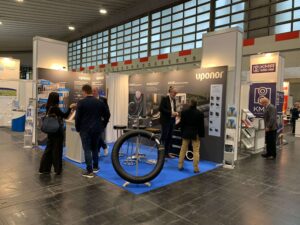
KWD-globalpipe, 01.12.2023. With a consistent focus on the heating sector, the HEATEXPO 2023 presented a 360-degree environment with innovative technologies, new products and services for sustainable and innovative heating solutions. The focus was on local & district heating, gas and elec-tricity as well as heating and cooling networks.
The exhibiting companies came from the fields of pipe systems, plant engineering, equipment manufacturing, technology, project development, infrastructure, services and consulting. Around 100 exhibitors were present at the premiere of the new trade fair, companies from twelve countries with their solutions and technologies – including Sweden, Finland, Italy, Belgium, the Netherlands, Austria and the USA.
In this issue of KWD-globalpipe you will find exhibitor reports from the companies BRUGG Pipes, Danfoss, ENERPIPE, ISOPLUS, Kingspan LOGSTOR, REHAU, THERMAFLEX and Uponor.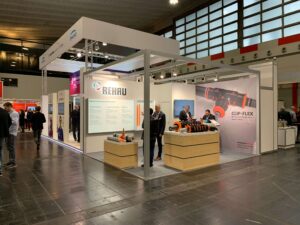
(If you are interested to read it, please send an email to hix@kwd-online.de with the subject “Send free copy of KWD-globapipe 903).
From the perspective of everyone involved, the new B2B show immediately managed to fill a gap and establish itself as a new forum for dialogue on all topics related to the move to renewable heating. There are many reasons for this success: the contributions of the partners involved, the comprehen-sive, informative supporting program and the opportunity at the venue to find out about new trends, technologies and solutions for tomorrow’s heating.
Above all, it was an unusually small but pleasant trade fair: One exhibition hall, many small exhi-bition

All Fotos: HIX Publishing, Jutta Hix
stands, intensive discussions were held everywhere and the supporting program with lectures, workshops etc. was quite well received. Organisers, exhibitors and visitors were all up-beat about the new show, and many have already confirmed their participation next ye
Contact: HeatExpo, Messe Dortmund /DEU, www.heat-expo.de.
Subscribe to industry news
Industry news in English language

Industry News in German language
Market Reports